
Static Backdrops or Interactive Displays: Which Creates a Stronger Event Experience?
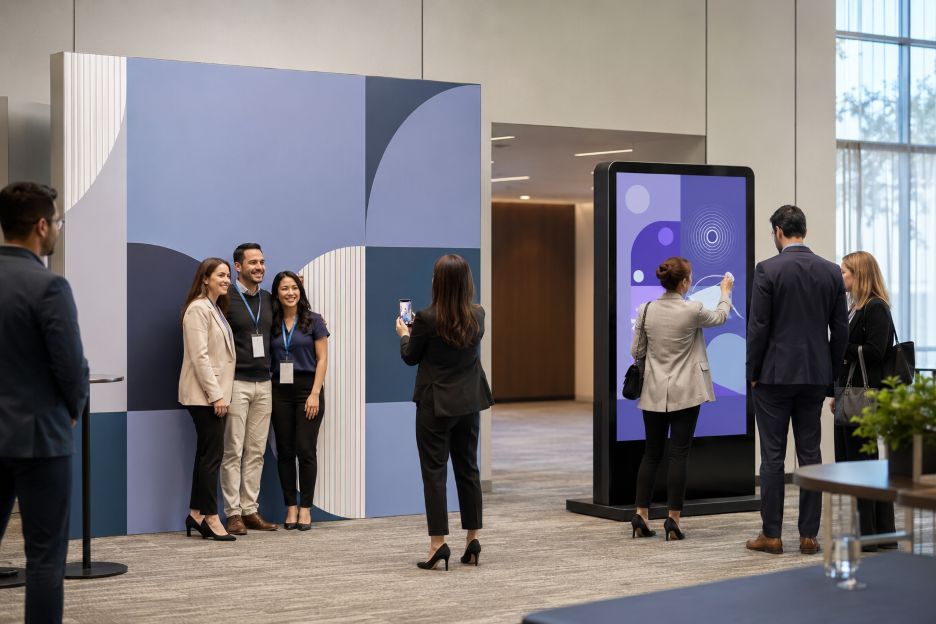
Event displays influence how guests navigate a venue, understand its identity, and remember the occasion. Static backdrops and interactive screens can both support these goals, but they create different experiences. One offers visual stability, while the other introduces movement and participation. The stronger choice depends on what organizers need the display to accomplish.
Static graphics remain common because they provide a controlled background for arrivals, interviews, and formal photographs. A conventional step and repeat NYC display, for example, can place a repeated visual identity behind every guest without requiring software or power. Its fixed design helps photographers predict what will appear in the frame, even when many people use the area throughout an event.
The Case for Static Backdrops
A printed backdrop offers consistency. Once its dimensions, colors, and graphic spacing have been approved, the presentation remains unchanged. This reliability can be valuable at award ceremonies, conferences, media events, and private celebrations where photographs need a uniform visual setting. Guests do not have to wait for an animation to finish or learn how to operate an interface.
Setup is generally straightforward, although the structure must still be stable and properly positioned. Organizers can install the graphic, test the lighting, and leave it ready for repeated use. There are no application updates, network interruptions, failed sensors, or delayed content loads to manage. These practical qualities can reduce the technical demands placed on a small event team.
Visual simplicity also benefits photography. A static surface gives a photographer time to balance exposure, subject lighting, and background detail. Designers can apply contrast principles when choosing colors and arranging supporting information. Although its standards were created for digital accessibility, World Wide Web Consortium guidance demonstrates why sufficient contrast makes visual information easier to distinguish. Its WCAG guidance recommends a contrast ratio of at least 4.5:1 for ordinary text and 3:1 for large text.
Static backdrops have limitations, however. They cannot change with the program, personalize content for individual attendees, or respond to audience actions. A design prepared for one campaign may also become outdated when sponsors, dates, or messages change. Large printed pieces require transport and storage, while single-use graphics can create material waste.
The Case for Interactive Displays
Digital screens, projections, and augmented-reality experiences approach event branding differently. Their content can move, rotate, or change in response to a schedule. A screen might welcome guests, show live results, display audience contributions, and later become part of a presentation. This flexibility allows one physical installation to serve several communication needs during the same event.
Interactive systems can also turn spectators into participants. Touchscreens may let visitors explore information at their own pace, while motion sensors can trigger animations. Augmented reality can layer digital objects over a physical venue through a phone, tablet, or headset. A review published by Frontiers in Virtual Reality, covering 722 studies, identified user experience as a major theme in research on immersive museum technology. The findings show growing interest in how AR, VR, and mixed reality shape cognitive, emotional, and behavioral experiences.
Yet interaction adds complexity. Equipment must be powered, tested, monitored, and accessible to the expected audience. A clever activation may attract attention but still fail if its instructions are unclear or queues become too long. Some guests may prefer to observe rather than participate, and unfamiliar controls can exclude people who have limited mobility, vision, technical confidence, or time.
Venue conditions matter as well. AVIXA, the Audiovisual and Integrated Experience Association, explains that projection works best under controlled lighting because ambient light can weaken the image. Bright outdoor spaces or illuminated exhibition halls may therefore require stronger projectors, direct-view LED screens, or additional light control.
Finding a Balanced Solution
The comparison is less about identifying a universal winner than matching the display to the event. A formal press call may benefit from a fixed background that keeps photographs consistent. A product demonstration, educational exhibition, or technology conference may gain more from changing content and hands-on exploration. Audience behavior should guide the choice. Guests moving quickly through a reception area need immediate visual clarity, while visitors staying longer may welcome an interactive layer.
Budget decisions should include more than the initial purchase price. Printed graphics involve production, shipping, mounting, storage, and possible replacement. Digital systems add equipment rental or purchase, content development, technicians, power, and contingency planning. Reusable hardware can support several events, but it provides value only when organizers have suitable content and the resources to operate it reliably.
A hybrid system can resolve some of the tension while preserving a consistent visual identity across the venue. Organizers might use a dependable printed background for official photographs and place an interactive installation nearby for informal participation. Projection can animate selected areas while permanent graphics preserve essential information. This separation prevents technical experimentation from disrupting core event functions.
Choosing for the Experience
Static backdrops are strongest when consistency, speed, and photographic control are priorities. Interactive displays are more suitable when changing information, personalization, and audience participation support the event’s purpose. Neither format creates engagement by itself. Clear content, readable design, reliable operation, and thoughtful placement remain essential.
Event planners should therefore begin with the desired guest behavior rather than a preferred technology. If people should pose, recognize the identity, and move along, a fixed display may be enough. If they should explore, respond, or contribute, an interactive system may add meaningful value. When both behaviors matter, a carefully planned hybrid environment can offer stability and participation without allowing one to weaken the other.


